By Dean O’Neill and Russell Holter
PNRA volunteers are getting older. Diversifying our base and attracting young people is paramount to the organization’s long-term viability. The PNRA must strengthen our volunteer base and give the organization a much-needed transfusion. Former Executive Director Jonathan Fischer and Board President Russell Holter worked to develop a graduate-level internship program.
An internship is a short period of work (typically three months) in businesses, non-profit organizations, and government agencies. They are usually undertaken by students and graduates looking to gain relevant skills and experience in a particular field. In return, the host organization will evaluate and provide feedback to the intern while also completing some work or projects that are mutually beneficial. PNRA gives the college feedback on the intern’s job performance and professionalism.
Last winter, the PNRA hosted a graduate-level intern from the University of Washington School of Information Science – Eric Flores. Interestingly, Flores reached out to our organization, but we were not seeking an intern then. However, we realized the value of such a program and quickly set up the logistics to achieve our mutual goals. Eric worked at the archive every Thursday from January through March and Dean O’Neill mentored him.
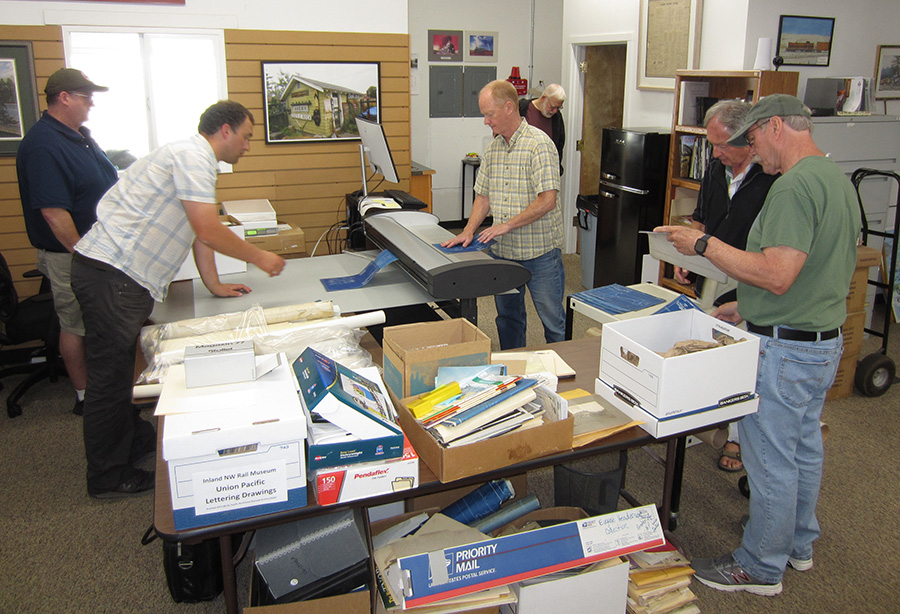
Flores met with O’Neill and agreed to complete two projects during his term. The first was a major “housecleaning” of the digital files on our archive file server (PNRA50) and its sister working file server (PNRA45). The work included eliminating duplicates, consolidating folders, renaming folders for clarity, and other general housecleaning. Eric drove meetings with to-do lists, reached out to PNRA volunteers, and performed file actions on the servers. The second project entailed creating a start-to-finish user guide for newcomers to learn and leverage our new computer resources. We wanted to give a newbie to the PNRA a chance to walk in the door and get up and running on our computers and scanners within 10 minutes or so, including which PC to use, how to log in, where to store files, and where to locate the Finding Aids. This second project was the most successful and is essentially complete. The first project was also very successful, but not all the volunteers could finish their to-do lists before Flores left. Eric also completed some smaller tasks, such as scanning old NP-related negatives for the first time.
Overall, the internship was a big success for Flores and PNRA. Eric received valuable experience at a local, functioning archive while adding O’Neill and the PNRA to his list of References. The PNRA made substantial progress in two crucial areas that otherwise might not have received their deserved attention—a win-win. Looking at the big picture, the exercise demonstrated that college intern programs could successfully partner with the PNRA, with mutual benefit. With the right intern and mentor in position, realistic goals, and projects, a template has been established moving forward.
The Flores experiment was a proof of concept for Fischer and Holter. The PNRA recently signed agreements with two organizations, the University of Washington and the Masters of Library and Information Sciences program at the University of Denver. Also, PNRA Board President Russell Holter was recently named a Graduate Advisor for Norwich Military Academy of Northfield, Vermont. The PNRA will receive 225 hours of graduate-level expertise this fall with the two signed agreements.
The PNRA’s fall graduate intern is Alex Soriano of Bainbridge Island. Soriano is keenly interested in learning about archival management, record keeping, and the creation of finding aids. When told that we are in the process of incorporating Excel data into AtoM, Soriano was intrigued. He and his colleagues have been using PastPerfect. Experience with AtoM will provide Soriano with valuable insight into a database significantly different from what his colleagues are accustomed to. Soriano will be working most Tuesdays and Saturdays beginning in September.
The university contracts are unique. So too, are the program requirements. With the University of Denver, the PNRA will shepherd our intern for 75 hours. The University of Washington program requires interns to apply themselves to on-the-job internships for at least 150 hours. For comparison, the Norwich University program requires 300 hours and an intern-derived capstone project. The student, the university, and the organization must mutually agree upon the capstone project.
To remain competitive and attract the best and brightest of the University of Washington’s pool of graduate interns, the PNRA is committed to providing an educational stipend of $1,500.00. Yes, we could have offered the opportunity and expected the intern services to be provided to the PNRA pro bono. However, those organizations that offer modest stipends are more likely to be solicited by graduate students. For example, Seattle’s main branch library compensates an amount roughly equal to the quarterly tuition (approximately $3,000.00) on top of an hourly salary. PNRA, in no way, is going to attempt to compete with a city-financed organization like the library. Still, it does demonstrate just how competitive the graduate intern market has become. O’Neill interviewed three candidates and chose Lily Woodard for the program.
If you have questions about the internship program or would like to mentor a graduate student for a quarter, don’t hesitate to contact us.